> For the complete documentation index, see [llms.txt](https://docs.b2b-sellers.com/b2b-platform/llms.txt). Markdown versions of documentation pages are available by appending `.md` to page URLs; this page is available as [Markdown](https://docs.b2b-sellers.com/b2b-platform/user-guide/configuration/e-mail-templates.md).
# E-Mail Templates
## Managing Mail Template Updates
When you update the B2Bsellers Suite, existing mail templates in your database are not automatically overwritten. We do this to protect any custom branding or text changes you may have already made.
However, newer versions often include important logic updates or new variables. To benefit from these, you can manually compare your templates with the latest versions and update them as needed.
{% hint style="info" %}
If you have customized your templates extensively, we recommend copying the raw code from the plugin directory into a staging environment first to ensure any new variables (like `activationUrl`) work correctly with your design.
{% endhint %}
## Where to Find the Templates
All default mail templates provided by the B2Bsellers plugin are located in the following directory: `src/Setup/MailTemplates`
Each template is available in:
* Languages: German and English (additional languages can be added manually).
* Formats: Both Plain Text and HTML versions.
### Identifying B2Bsellers Templates in Admin
To find and edit these templates within your Shopware environment:
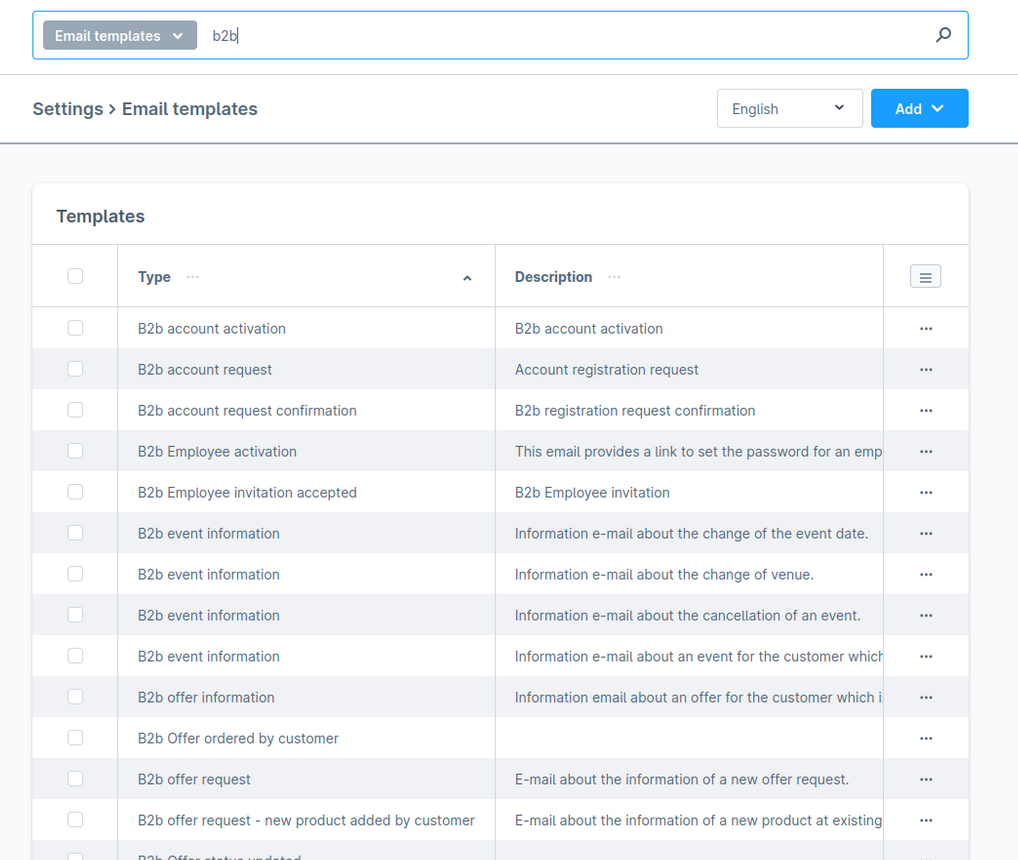
1. Navigate to Settings > Shop > Email templates.
2. Use the search bar at the top and enter keywords like "b2b" or "b2bsellers".
3. This will filter the list to show the specific templates created by the suite.
searching for b2b in email templates
---
# Agent Instructions
This documentation is published with GitBook. GitBook is the documentation platform designed so that both humans and AI agents can read, navigate, and reason over technical content effectively. Learn more at gitbook.com.
## Querying This Documentation
If you need additional information that is not directly available in this page, you can query the documentation dynamically by asking a question.
Perform an HTTP GET request on the current page URL with the `ask` query parameter, and the optional `goal` query parameter:
```
GET https://docs.b2b-sellers.com/b2b-platform/user-guide/configuration/e-mail-templates.md?ask=&goal=
```
`ask` is the immediate question: it should be specific, self-contained, and written in natural language.
`goal` is optional and describes the broader end goal you are ultimately trying to accomplish on behalf of the user. GitBook uses it to tailor the answer towards what is most useful for that goal.
The response will contain a direct answer to the question and relevant excerpts and sources from the documentation.
Use this mechanism when the answer is not explicitly present in the current page, you need clarification or additional context, or you want to retrieve related documentation sections.